Analysis-Trump’s recall of ambassadors compounds staffing problems at posts in Africa
WASHINGTON, Dec 24 (Reuters) – U.S. President Donald Trump’s mass recall of ambassadors will leave Washington without top-level presence in more than half of the countries in sub-Saharan Africa, complicating America’s efforts to push its agenda in a region that has faced military coups and devastating conflicts in recent years.
Since taking office, the administration has worked to implement its business-focused diplomacy in Africa, shifting the U.S. priority from aid to trade. Trump has sought to broker peace accords and rare-earth deals and has struck bilateral agreements instead of providing direct foreign assistance.
Trump has touted the U.S. as a better partner to African countries than China, saying he was committed to strengthening friendships in the region in the latest effort by successive U.S. administrations to counter perceptions of U.S. neglect of a continent where China has increasingly made economic inroads.
U.S. embassies across Africa and the State Department’s Africa Bureau in Washington have chronically been understaffed across several administrations. But now, Trump’s ouster of 13 chiefs of mission as reported by the Associated Press will bring the total top-level vacancies in the region to roughly 30. Former diplomats and experts said this number will inevitably have an impact on America’s diplomacy.
It was unclear whether the State Department planned to replace those who are being recalled. The department did not provide answers on when they intended to replace them.
The recall of top envoys reflected Trump’s “personal style”, said Cameron Hudson, a former U.S. official who worked on Africa, given the Republican president has taken an active role in the peace accord between Democratic Republic of Congo and Rwanda as well as in actions against Nigeria over the killing of Christians.
That approach, Hudson said, misses the point of diplomacy and engagement and undermines efforts by diplomats to shape attitudes and interests.
Trump feels “He doesn’t need ambassadors, because he’s managing these relationships, even with 54 African countries, himself. So if he’s not personally engaged, then that country doesn’t merit his engagement. If he is personally engaged, then why does he need an ambassador?,” Hudson said.
Aside from Trump himself, Massad Boulos, father-in-law of Trump’s daughter Tiffany and senior adviser for Arab and African Affairs, has played a major role in negotiations between Congo and Rwanda. He has also tried to help end the war in Sudan.
LEADERSHIP GAP?
Despite former President Joe Biden’s repeated pledges to focus more on Africa, U.S. influence in the continent declined during his term. Washington lost a military base in the Sahel region and made little progress breaking China’s commercial domination in minerals seen as critical to national security.
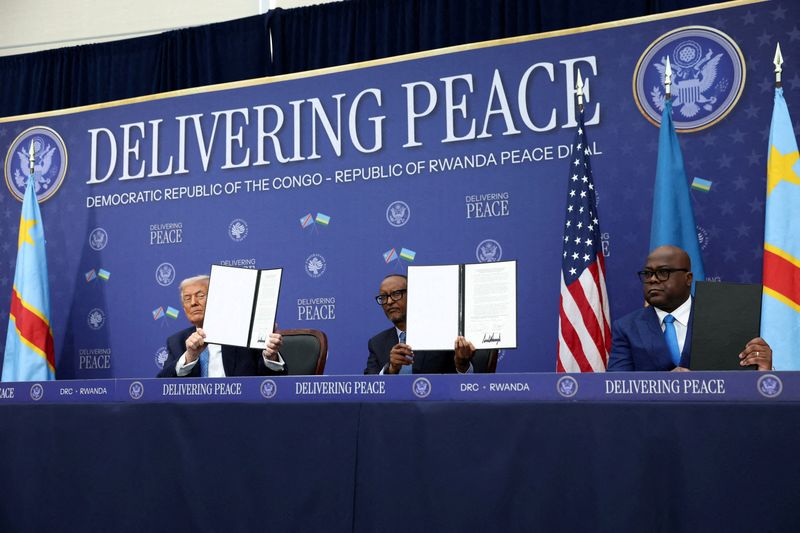
Much of Trump’s focus in the region has been on mediating a peace deal to end the conflict in eastern Congo, as the Republican president sought diplomatic acclaim for international peacemaking. However, just days after Trump and leaders of Congo and Rwanda reaffirmed a peace deal, Rwanda-backed M23 rebels made their biggest advance in months.
Trump also has feuded with South Africa and added Nigeria to a list of countries of concern, threatening military action if the West African nation fails to crack down on the killing of Christians.
Among U.S. envoys recalled were those serving in Rwanda and Nigeria, according to the AP, as well as Niger, where this year a U.S. pilot working for a missionary agency was kidnapped.
“The Trump Administration is delivering unprecedented success in advancing America’s national interests in Africa,” Tommy Pigott, principal deputy spokesperson for the State Department, said.
“Those successes — from commercial and trade deals to historic health and peace agreements — are a direct result of President Trump’s tremendous leadership and the professionalism of American diplomats. That’s the real story.”
The State Department did not confirm AP’s reporting on the number of ambassadors recalled.
RISING TO CHALLENGES
Even after high-level engagement by Boulos, it still falls to the embassy to do the follow-up work, said Tibor Nagy, who was the top Africa official at the State Department during Trump’s first term. He said the vacancies were “an extremely high number,” though added that assessment was based on his impression rather than data.
In addition to the overseas missions, leadership of the Africa Bureau at the State Department will also be going through personnel changes with Senior Bureau Official for African Affairs Jonathan Pratt retiring.
In an email seen by Reuters, Pratt told staff that when he took on the position, he had agreed to serve in the role through the end of the year. “While historically understaffed, the AF bureau constantly rises to every challenge and takes advantage of every opportunity,” he said.
The bureau’s Deputy Assistant Secretary Nick Checker will step into the role after Pratt’s departure, a State Department spokesperson said. Checker will be the third official to take on the role under Trump’s second term, after the retirement of Pratt and Troy Fitrell.
Trump has yet to nominate a candidate for Assistant Secretary of State for African Affairs, a Senate-confirmed position. The State Department did not address a question on when the administration would make that nomination.
Nagy, who was a key department official in the first months of the current Trump administration, said the lack of a nominee “definitely can hurt the operations of the bureau.”
Nagy, who also served as U.S. ambassador to Ethiopia and Guinea, said that while Checker is “qualified, competent … at some point you really do need to have a Senate-confirmed assistant secretary.”
(Reporting by Daphne Psaledakis and Simon LewisEditing by Humeyra Pamuk and David Gregorio)